When raising capital for your startup, choosing between a SAFE (Simple Agreement for Future Equity) and a convertible note can significantly impact your company’s future. Both instruments allow startups to raise money without immediately setting a valuation, but they differ in fundamental ways that affect founders, investors, and long-term business outcomes.
What is a SAFE?
A Simple Agreement for Future Equity (SAFE) is a contract where an investor provides capital in exchange for the right to receive equity in the future. Introduced by Y Combinator in 2013, SAFEs were designed to be simple and founder-friendly financing instruments.
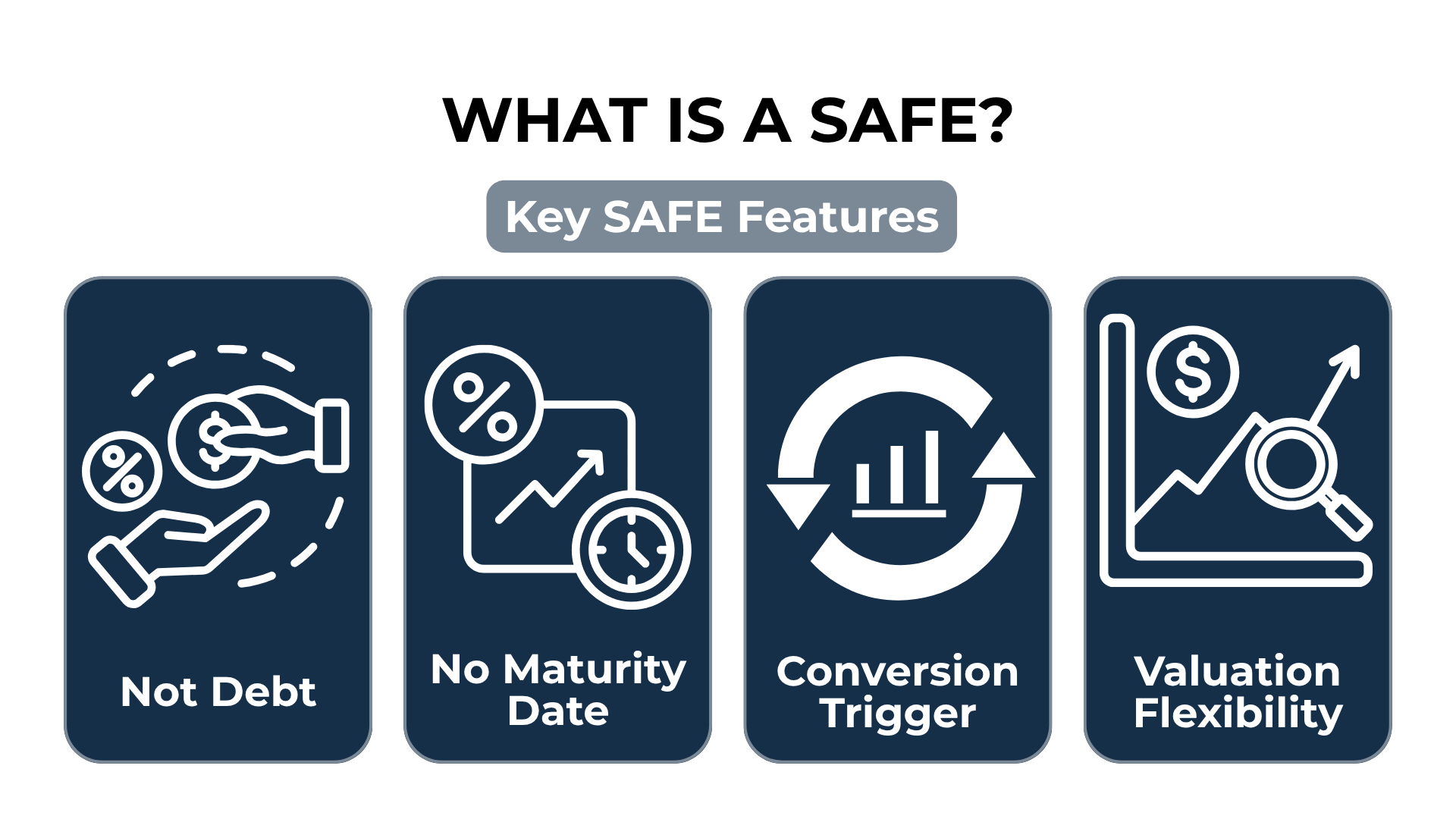
Key SAFE Features:
- Not debt: SAFEs are equity-based with no interest or repayment obligations
- No maturity date: No deadline for conversion or repayment
- Conversion trigger: Converts to equity during a future priced round or liquidity event
- Valuation flexibility: Often includes a valuation cap or discount rate
Example: An investor provides $50,000 via a SAFE with a $2 million valuation cap and 20% discount. In a $5 million Series A round at $5/share, the SAFE converts at $4/share due to the discount, or at the cap’s lower valuation if applicable.
What is a Convertible Note?
A convertible note is a short-term debt instrument that converts into equity, typically during a subsequent funding round or at maturity. It’s a traditional financing tool that has been used longer than SAFEs.
Key Convertible Note Features:
- Debt instrument: Accrues interest (typically 6-8% annually) with a maturity date
- Maturity timeline: Usually 1-3 years
- Conversion requirements: Converts during qualified financing rounds or at maturity
- Investor protections: May include valuation cap, discount rate, or Most Favored Nation (MFN) clause
Example: A $50,000 convertible note with 6% interest and 20% discount converts after one year in a $1 million round at $2/share. With accrued interest ($3,000), the note converts at $1.6/share due to the discount.

SAFE vs Convertible Note: Key Differences
| Aspect | SAFE | Convertible Note |
| Nature | Equity-based, no debt | Debt-based, converts to equity |
| Interest | No interest | Accrues interest (6-8% annually) |
| Maturity Date | No maturity date | Has maturity date (1-3 years) |
| Conversion Trigger | Next priced round or liquidity event | Qualified financing round or maturity date |
| Valuation | Defers valuation, uses cap or discount | May have predetermined valuation cap |
| Complexity | Simpler, fewer terms to negotiate | More complex, includes debt terms |
| Investor Protections | Limited (valuation cap, discount) | More robust (interest, maturity, MFN) |
| Typical Use | Early-stage startups with uncertain valuation | Startups with some traction, investor preference for debt |

Pros and Cons of SAFEs
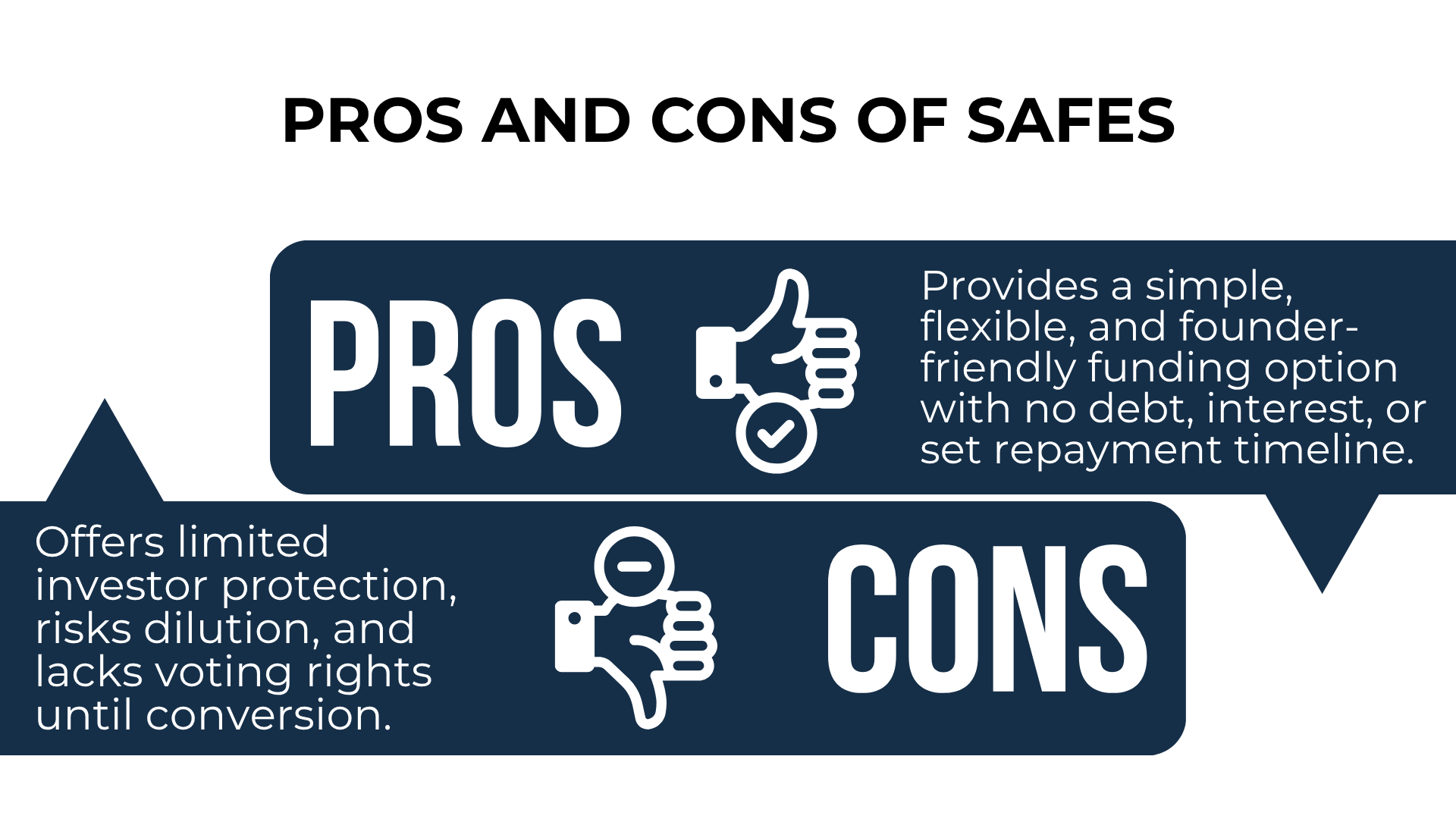
SAFE Advantages:
- Simplicity: Standardized templates reduce legal costs and negotiation time
- Clean balance sheet: No debt obligations or interest payments
- Flexibility: No maturity date allows focus on growth without repayment pressure
- Founder-friendly: Defers valuation, giving time to build traction
SAFE Disadvantages:
- Less investor protection: No interest or maturity date reduces investor upside
- Dilution risk: High valuations in future rounds can lead to significant founder dilution
- No voting rights: Investors aren’t shareholders until conversion
Pros and Cons of Convertible Notes
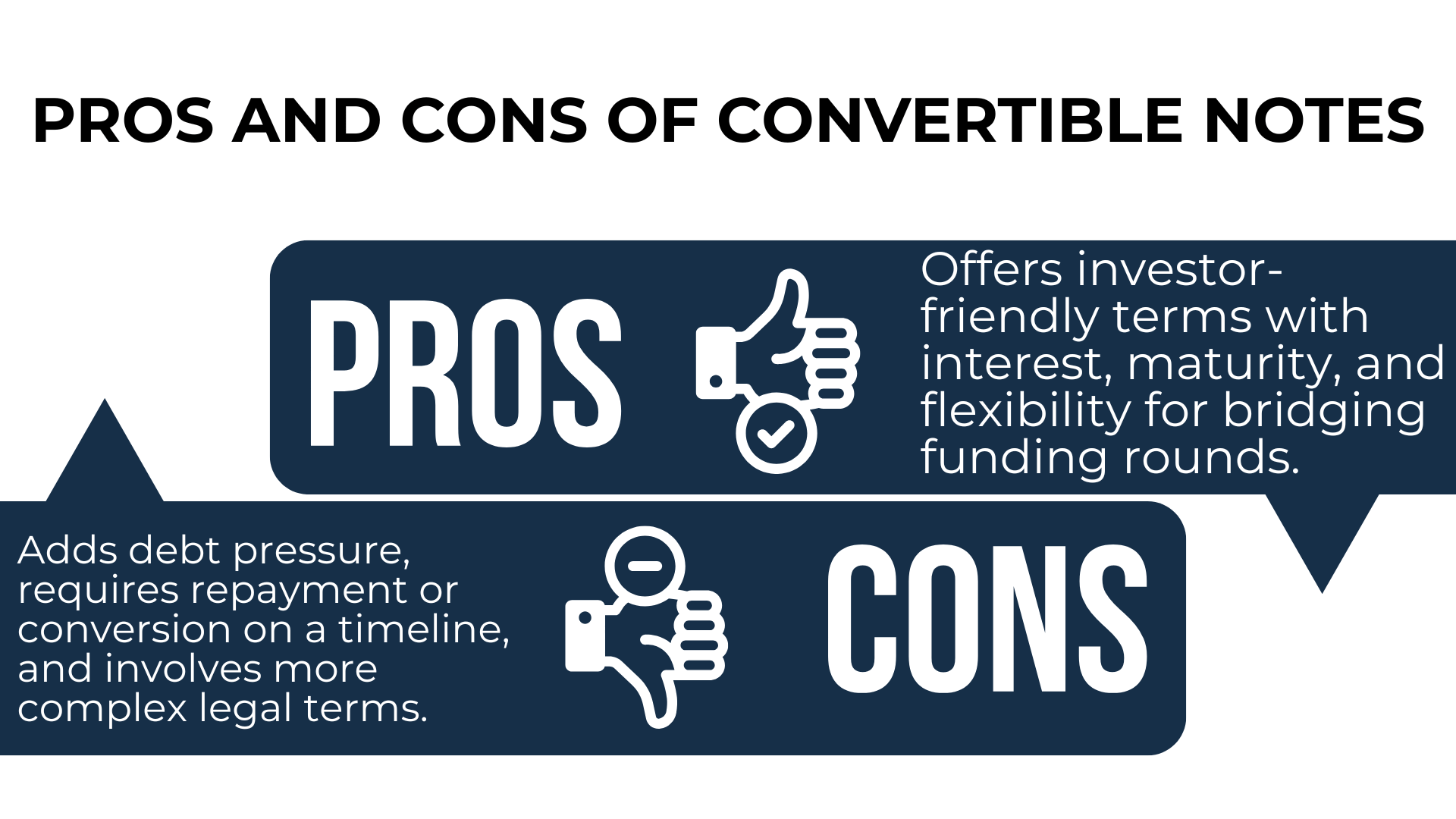
Convertible Note Advantages:
- Investor appeal: Interest and maturity provide financial returns and clear timeline
- Structured terms: Includes protections like interest, maturity, and MFN clauses
- Bridge financing flexibility: Suitable for funding between rounds with negotiable terms
Convertible Note Disadvantages:
- Debt burden: Interest accrual increases conversion amount
- Maturity pressure: Must convert or repay by maturity date, potentially straining cash flow
- Higher complexity: More terms increase legal costs and negotiation time
When to Use a SAFE
SAFEs work best for:
- Very early-stage startups (pre-seed or seed stage) with minimal traction
- Companies with uncertain valuation and little prior funding
- Founders wanting to avoid debt and maintain a clean balance sheet
- Startups planning a priced round within 1-2 years
SAFE Use Case Example:
A pre-seed startup with a prototype but no users might use a SAFE to raise $500,000, deferring valuation until a Series A round.

When to Use a Convertible Note
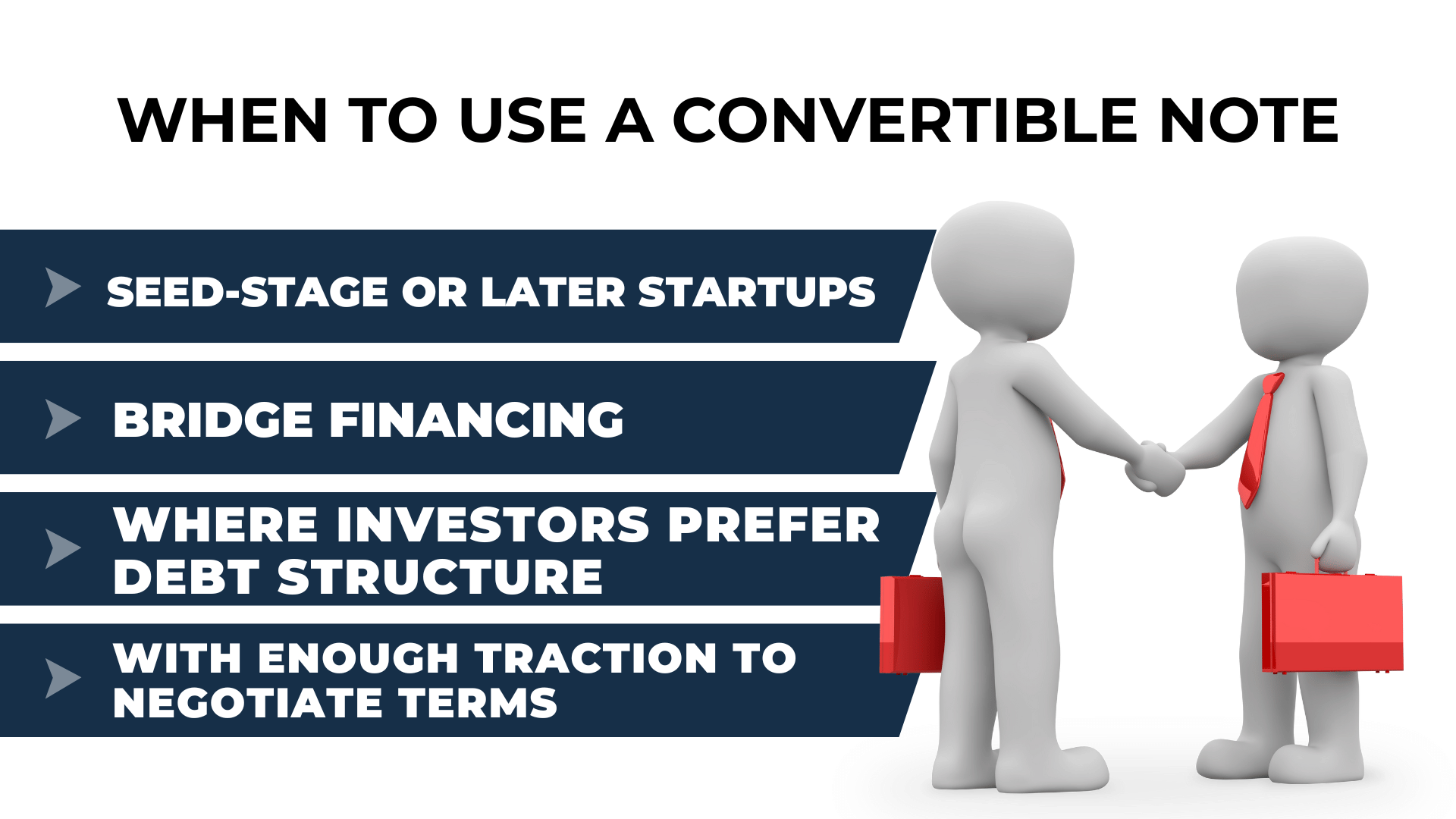
Convertible notes are ideal for:
- Seed-stage or later startups with some traction
- Bridge financing between funding rounds
- Situations where investors prefer debt structure with interest
- Startups with enough traction to negotiate terms but not ready for a priced round
Convertible Note Use Case Example:
A seed-stage startup with initial revenue might use a convertible note to raise $1 million, offering investors 6% interest and a 20% discount.
SAFE vs Convertible Note vs Priced Round Comparison
| Aspect | SAFE | Convertible Note | Priced Round |
| Definition | Equity agreement, converts later | Debt, converts to equity | Equity sold at fixed valuation |
| Typical Use | Raises up to $3M, early-stage | Raises up to $3M, bridge financing | Larger raises, growth stage |
| Pros | Simple, no debt, flexible | Investor protections, lower legal costs | No repayment, long-term investor support |
| Cons | Less investor protection, dilution risk | Debt burden, maturity pressure | Dilution, loss of control, high costs |

Common Concerns and Best Practices
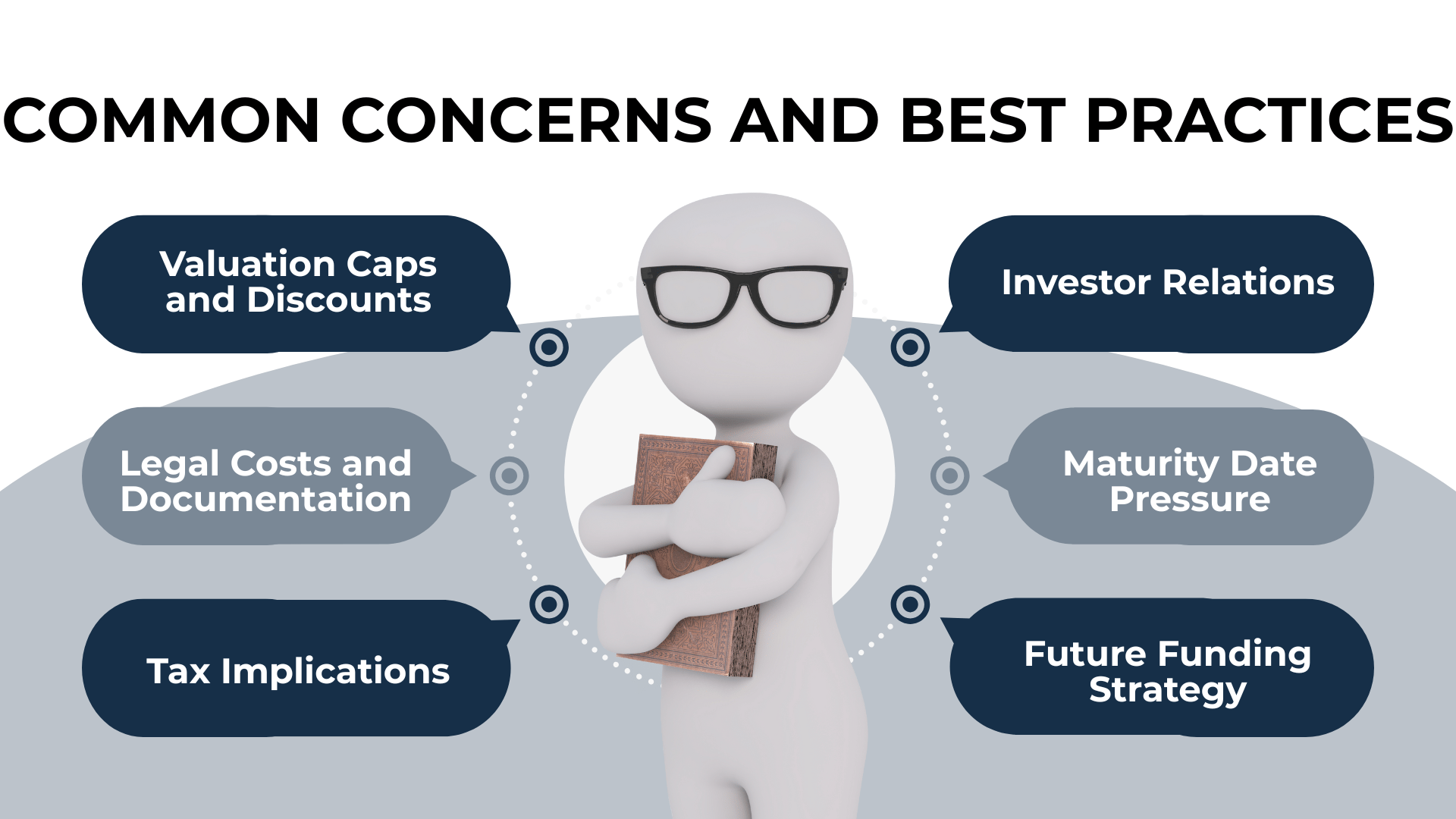
Valuation Caps and Discounts
- Concern: Setting caps too low leads to excessive dilution; high caps may not attract investors
- Best Practice: Negotiate based on market norms (e.g., 20% discount, $5-10M cap for early-stage startups). Model dilution scenarios to understand ownership impacts
Legal Costs and Documentation
- Concern: Complex convertible note terms increase legal fees
- Best Practice: Use standardized templates (Y Combinator’s SAFE or PandaDoc’s templates). Consult lawyers for complex situations
Tax Implications
- Concern: Tax treatment varies for companies and investors
- Best Practice: Understand QSBS eligibility for potential capital gains exclusions. Account for interest deductions on convertible notes
Investor Relations
- Concern: Misaligned expectations can strain relationships
- Best Practice: Communicate terms, conversion triggers, and funding plans clearly. Provide regular updates to all investors
Maturity Date Pressure (Convertible Notes)
- Concern: Notes reaching maturity without conversion can strain cash flow
- Best Practice: Plan fundraising timelines to align with conversion triggers. Negotiate extensions if needed
Future Funding Strategy
- Concern: Terms can impact future rounds
- Best Practice: Develop a clear plan for the next priced round. Consider how caps, discounts, and interest affect dilution
Frequently Asked Questions
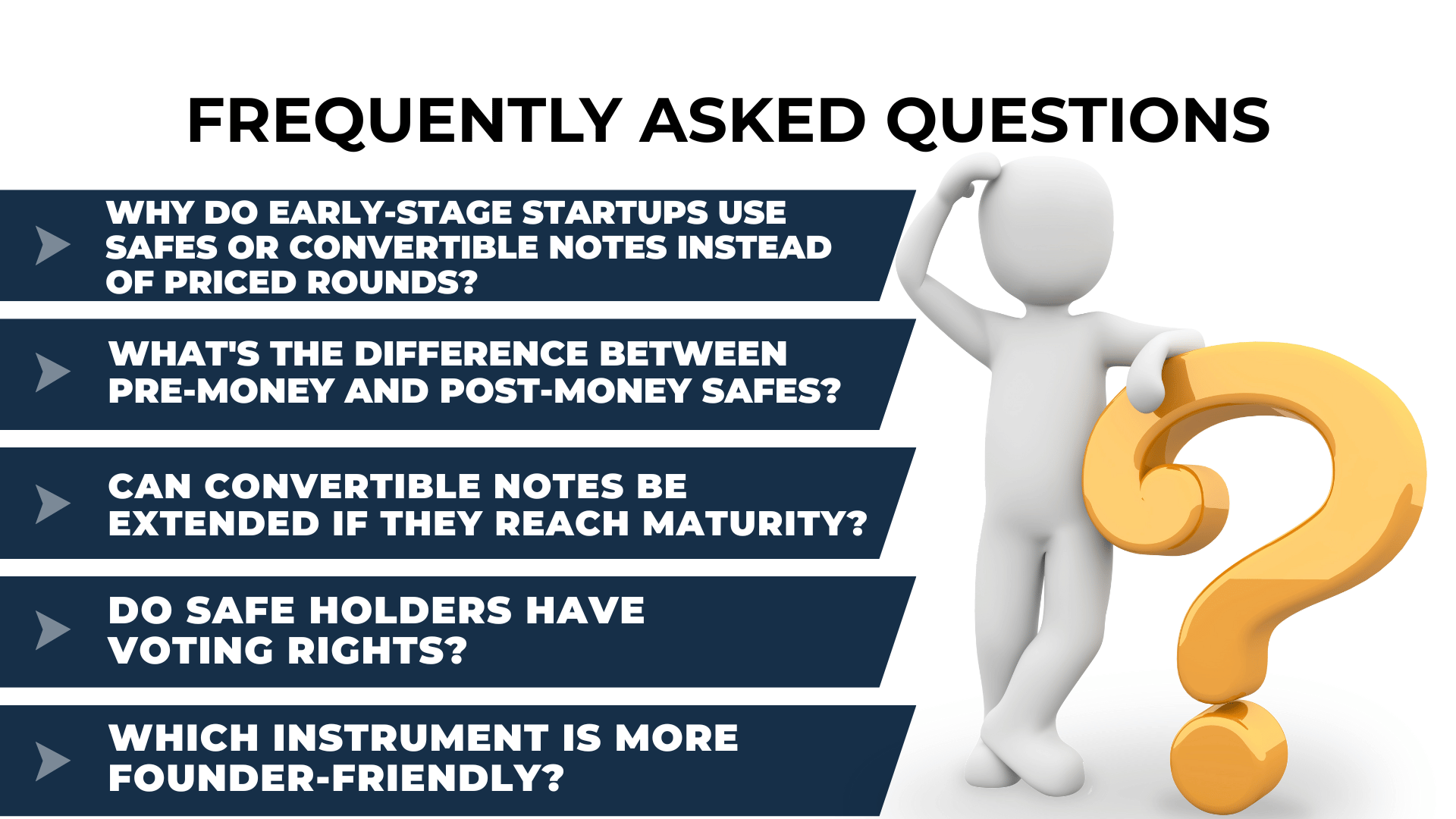
Why do early-stage startups use SAFEs or convertible notes instead of priced rounds?
Early-stage startups often lack the metrics (revenue, users) for a fair valuation, making priced rounds less feasible. SAFEs and convertible notes offer a quicker, simpler way to raise capital while deferring valuation.
What’s the difference between pre-money and post-money SAFEs?
SAFEs may be pre-money or post-money, affecting ownership calculations. This distinction impacts how dilution is calculated when the SAFE converts to equity.
Can convertible notes be extended if they reach maturity?
Yes, maturity dates can be negotiated and extended to avoid repayment demands, though this requires agreement from investors.
Do SAFE holders have voting rights?
No, SAFE holders are not shareholders until conversion, limiting their influence on company decisions.
Which instrument is more founder-friendly?
SAFEs are generally considered more founder-friendly due to their simplicity, lack of debt obligations, and absence of maturity dates.
Key Takeaways for Founders
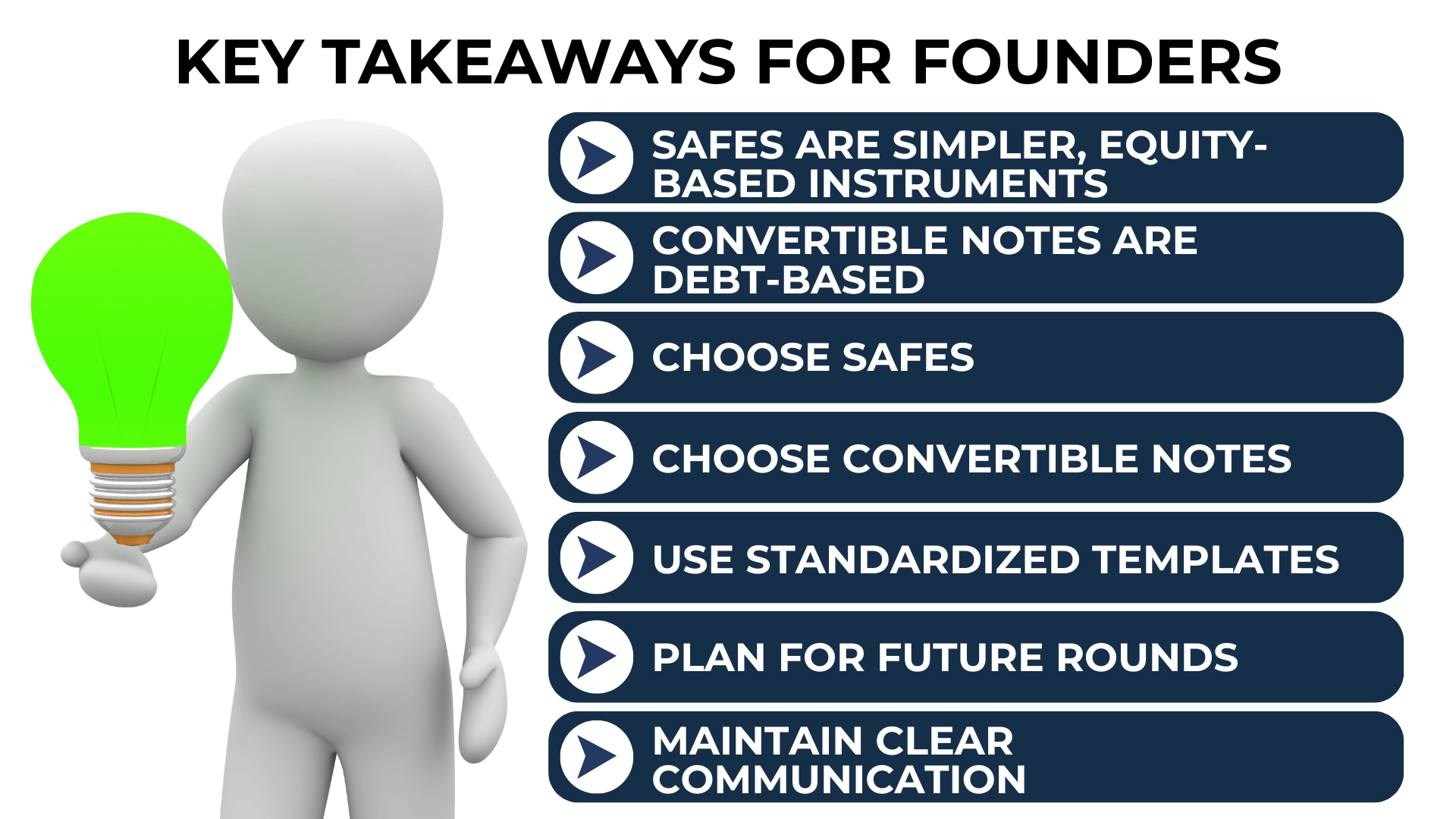
- SAFEs are simpler, equity-based instruments ideal for early-stage startups with uncertain valuations
- Convertible notes are debt-based, offering more structure and investor protections for startups with some traction
- Choose SAFEs for pre-seed or seed-stage fundraising when prioritizing simplicity
- Choose convertible notes for bridge financing or when investors prefer debt terms
- Use standardized templates to reduce legal costs and negotiation time
- Plan for future rounds to manage dilution and maturity pressures
- Maintain clear communication with investors about terms and expectations
Both SAFEs and convertible notes serve as interim funding tools for early-stage companies. The choice between them depends on your startup’s stage, investor preferences, and funding strategy. While SAFEs offer simplicity and founder-friendly terms, convertible notes provide more structure and investor protections. Understanding these differences helps founders make informed decisions aligned with their startup’s goals and investor expectations.