
Deciding where to incorporate your business is one of the most critical decisions you’ll make as a founder or business owner. With over 1.9 million business entities calling Delaware home—including more than 65% of Fortune 500 companies—you’ve likely wondered: should I incorporate in Delaware?
The answer depends on your business’s size, goals, and operational needs. This comprehensive guide examines the benefits, drawbacks, and practical considerations to help you make an informed decision.
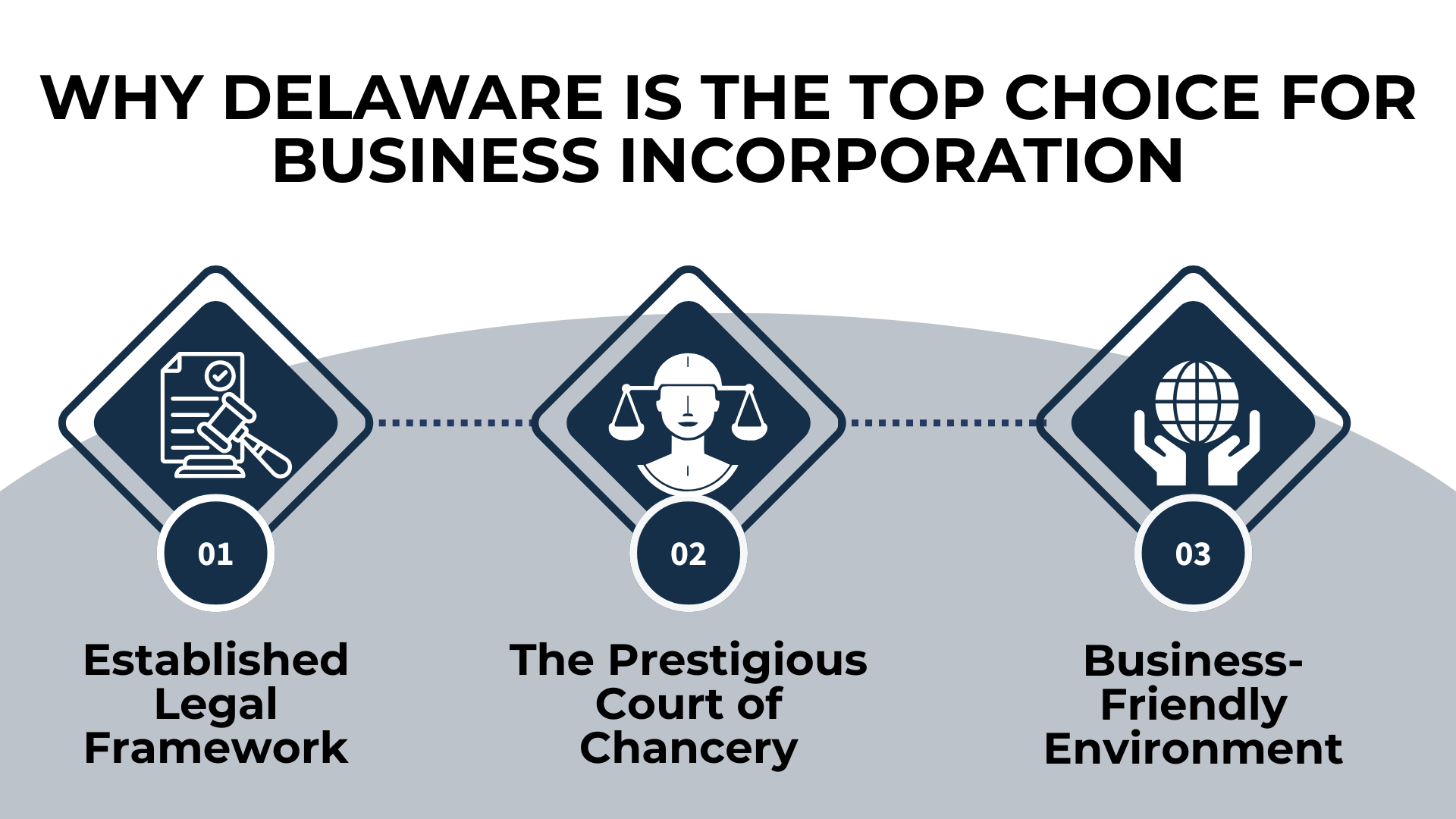
Why Delaware Is the Top Choice for Business Incorporation
Delaware’s reputation as America’s corporate capital isn’t accidental. Several key factors make it attractive to businesses of all sizes:
Established Legal Framework
- Well-developed corporate laws that are flexible and serve as models for other states
- Predictable legal environment that provides stability for business operations
- Progressive regulations that accommodate various business structures
The Prestigious Court of Chancery
- Specialized court dedicated exclusively to corporate law disputes
- Known for efficiency, expertise, and predictable outcomes
- Judges (not juries) handle cases, ensuring faster resolutions
- Extensive case law covering shareholder rights, mergers, and acquisitions
Business-Friendly Environment
- Streamlined incorporation processes
- Low initial filing fees (starting around $89 for corporations)
- Customer-service-oriented Division of Corporations
- Same-day filing available through certain registered agents
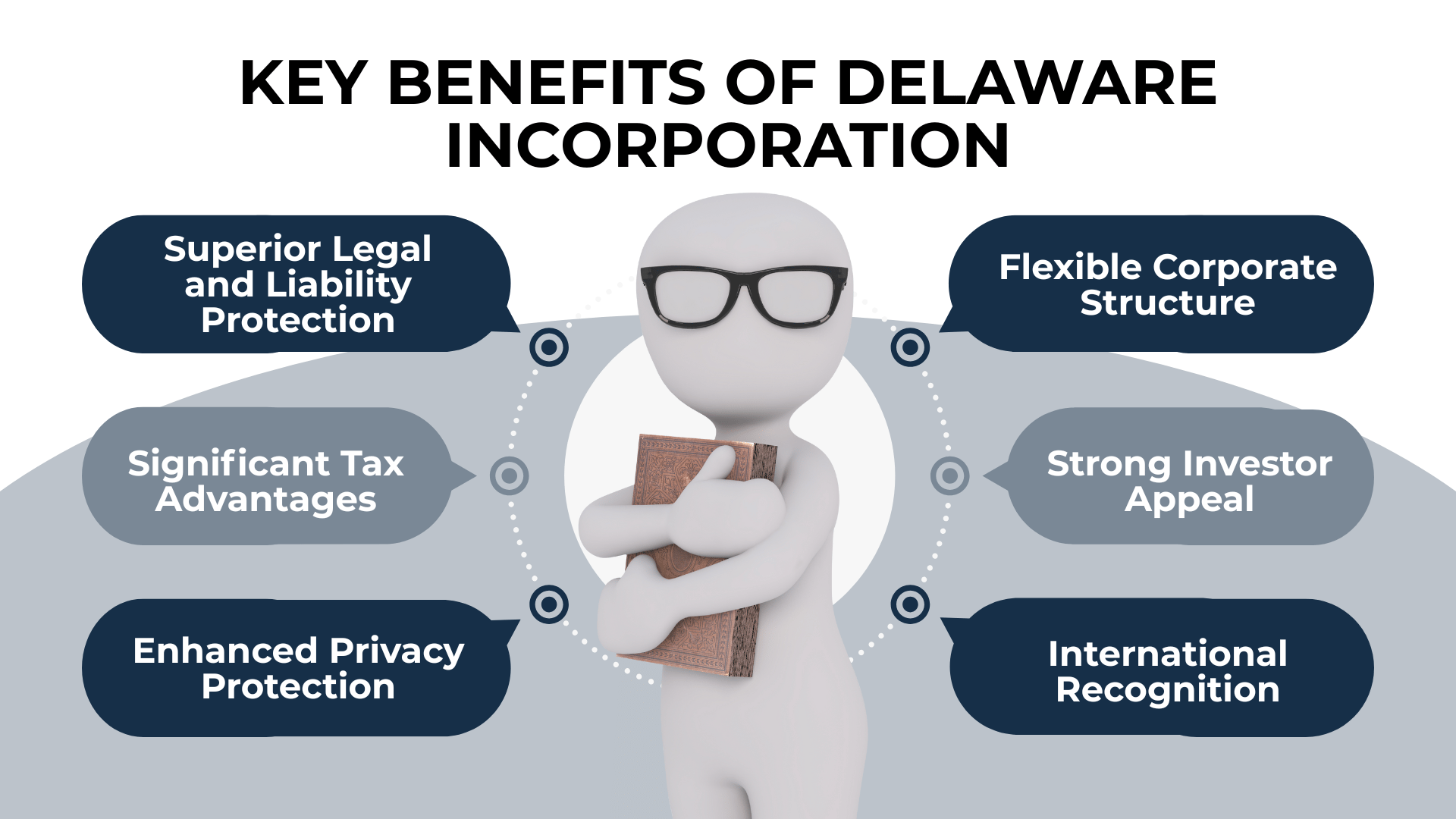
Key Benefits of Delaware Incorporation
1. Superior Legal and Liability Protection
Delaware offers unmatched legal protections for businesses:
- Progressive corporate laws allow customized governance structures
- The Court of Chancery provides predictable dispute resolution
- Extensive case law reduces uncertainty in legal proceedings
- Minimized liability risks for corporations and LLCs
2. Significant Tax Advantages
For businesses operating across state lines:
- No state corporate income tax for companies operating outside Delaware
- No inheritance tax on stock held by non-Delaware residents
- No state sales tax on intangible personal property like royalty payments
- No state business license required for non-Delaware operations
3. Enhanced Privacy Protection
Delaware prioritizes business owner privacy:
- File without disclosing director or officer names in initial incorporation
- LLC owner names and addresses remain private from public records
- Anonymous filings protect personal information
4. Flexible Corporate Structure
- One person can hold all corporate positions
- Single owner allowed for corporations
- Accommodates wide range of business structures
- Board of Directors can set stock prices to facilitate capital raising
5. Strong Investor Appeal
- Preferred jurisdiction for venture capitalists and angel investors
- Clear legal framework for investor rights and board governance
- Established fiduciary duty standards
- Enhanced credibility for fundraising efforts
6. International Recognition
- Improves credibility with international partners and customers
- Recognized globally as a business-friendly jurisdiction
- Facilitates international business relationships
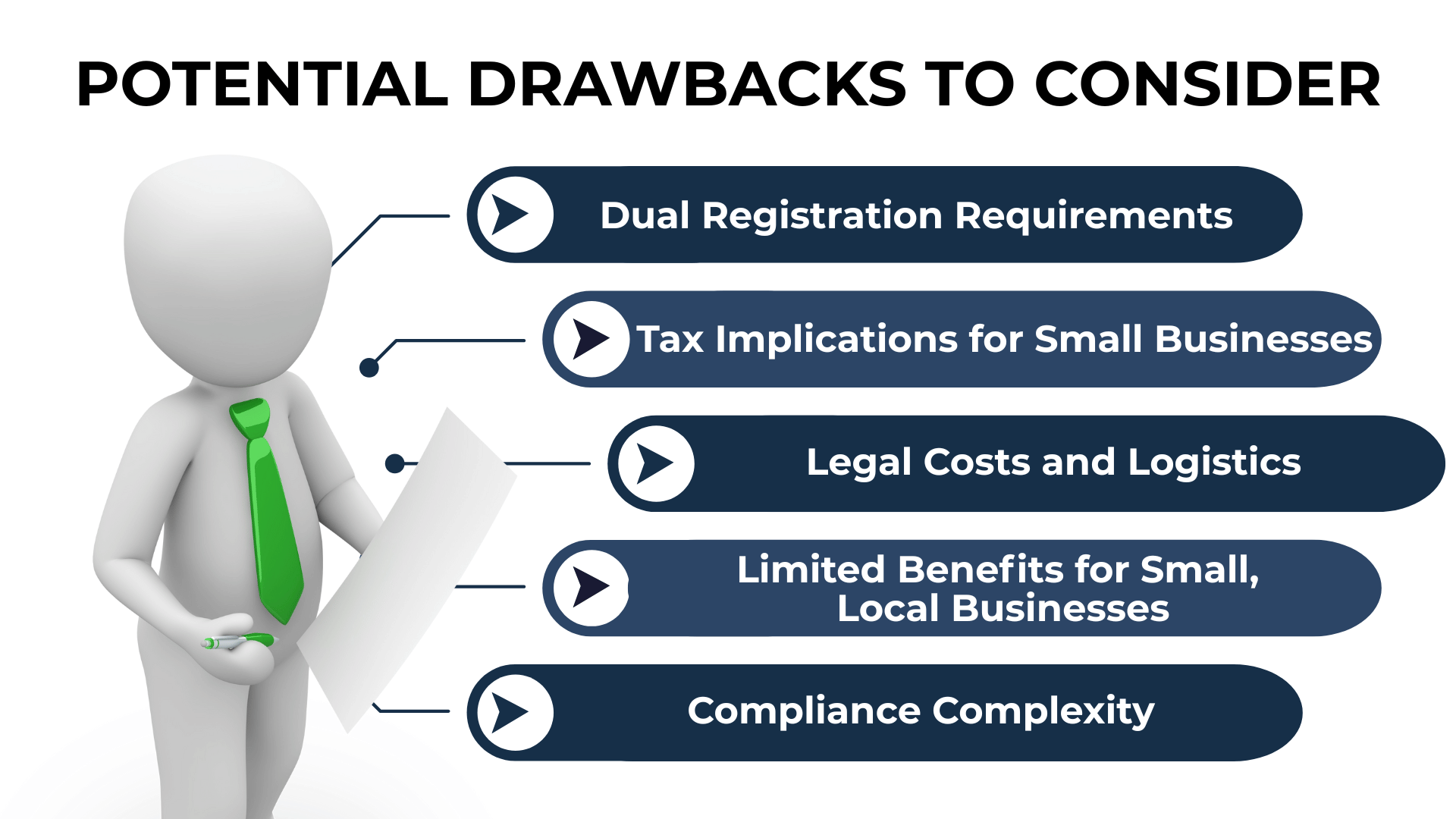
Potential Drawbacks to Consider
While Delaware offers substantial benefits, consider these potential disadvantages:
1. Dual Registration Requirements
If operating outside Delaware:
- Must register as a foreign entity in your home state
- Additional filing fees and annual reports required
- Dual compliance obligations increase administrative burden
- Example: California-based Delaware corporations pay $800 minimum annual franchise tax to California
2. Tax Implications for Small Businesses
- Home state may still tax your company’s income
- Delaware franchise tax based on shares and value can increase with growth
- Minimum $175 annual franchise tax for corporations
- Tax benefits may not offset additional costs for local businesses
3. Legal Costs and Logistics
- Corporate disputes handled in Delaware courts
- Requires Delaware-licensed attorneys
- Potential travel expenses for in-person proceedings
- Can be particularly burdensome for smaller businesses
4. Limited Benefits for Small, Local Businesses
- Advantages most pronounced for large corporations or VC-backed startups
- Local businesses may not need Delaware’s sophisticated legal framework
- Home-state incorporation often more practical and cost-effective
5. Compliance Complexity
- Must comply with both Delaware and home-state regulations
- Maintain registered agent in Delaware (typically $50-$200 annually)
- Meet home-state licensing requirements
- File annual reports in multiple jurisdictions
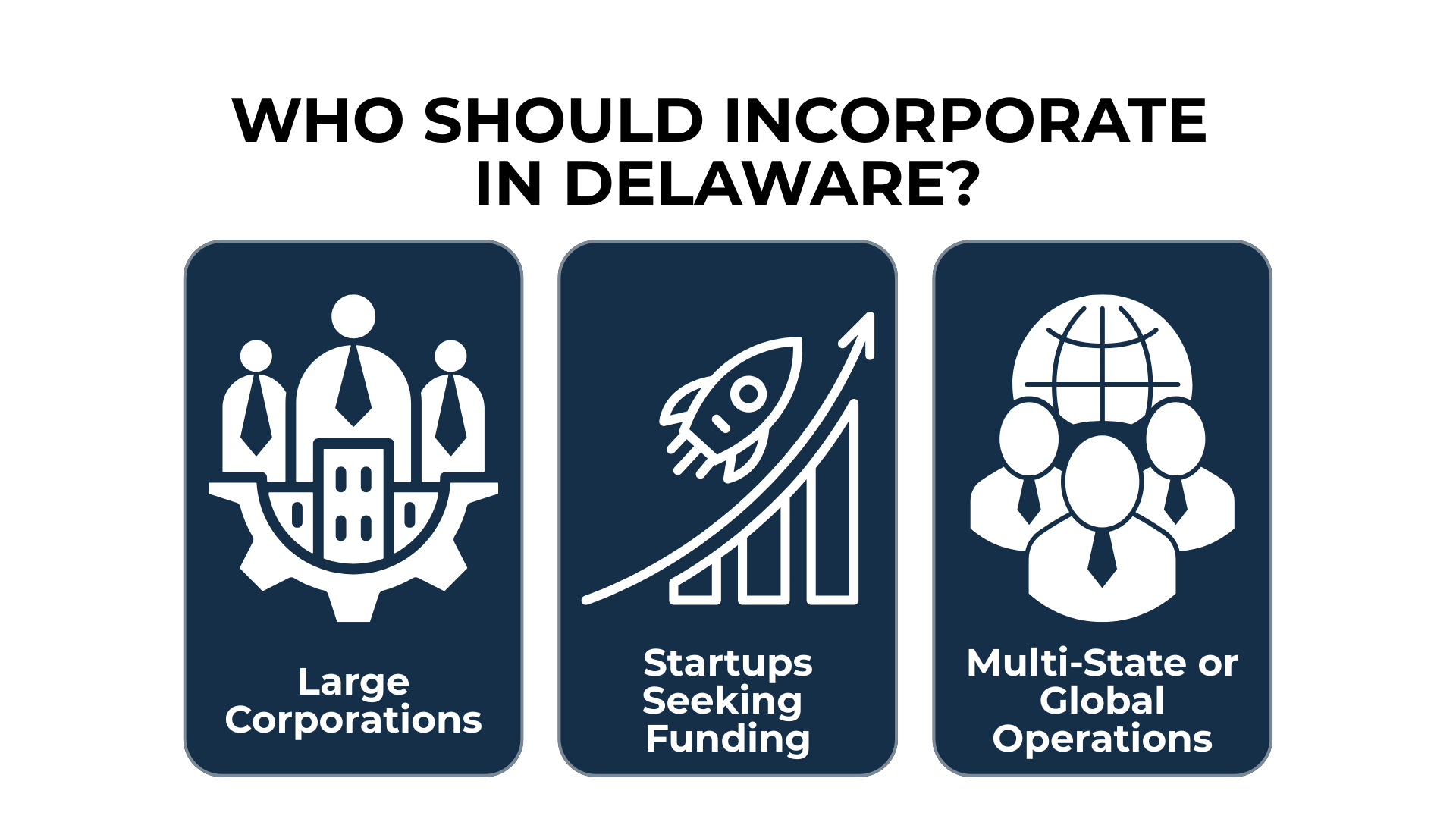
Who Should Incorporate in Delaware?
Delaware incorporation makes the most sense for:
Large Corporations
- Companies with complex structures
- Businesses with national or international operations
- Companies planning public listings
- Organizations needing sophisticated legal frameworks
Startups Seeking Funding
- Venture capitalists often prefer or require Delaware incorporation
- Angel investors familiar with Delaware’s investor-friendly laws
- Clear legal framework for equity structures
- Established standards for board governance
Multi-State or Global Operations
- Businesses operating across jurisdictions
- Companies benefiting from tax advantages
- Organizations needing international recognition
- Enterprises requiring legal predictability
Who Might Not Need Delaware Incorporation
Small, privately held businesses operating locally often find home-state incorporation more practical:
- Local retail stores
- Service-based businesses
- Companies not seeking outside funding
- Businesses with simple ownership structures
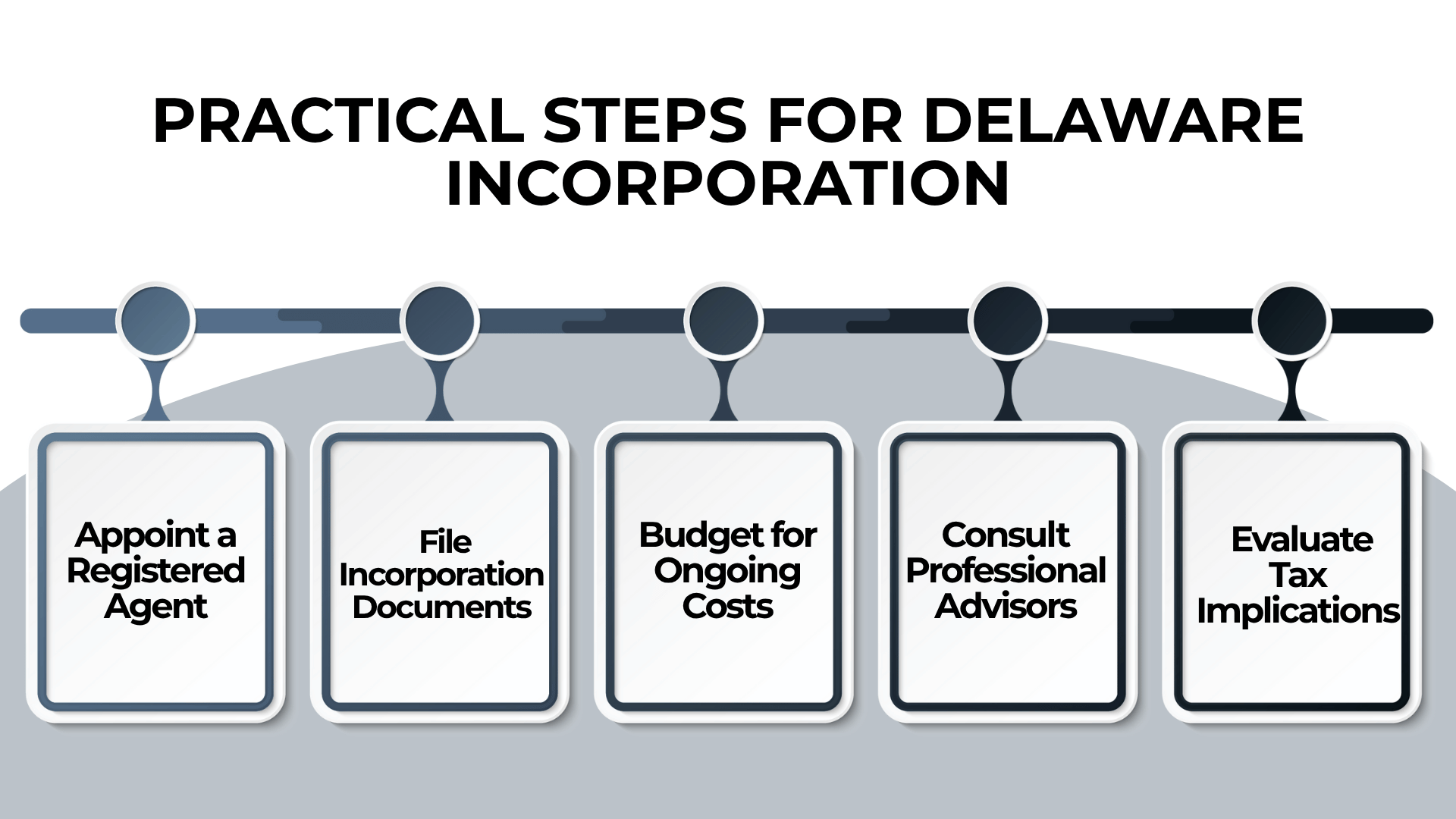
Practical Steps for Delaware Incorporation
If you decide to incorporate in Delaware, follow these steps:
1. Appoint a Registered Agent
All Delaware entities must maintain a registered agent. Popular services include:
- Harvard Business Services, Inc. (https://www.delawareinc.com/)
- LegalZoom (https://www.legalzoom.com/)
2. File Incorporation Documents
- Use Delaware Division of Corporations website (https://corp.delaware.gov/)
- Online filing available with low initial fees
- Process is straightforward and efficient
3. Budget for Ongoing Costs
- Annual franchise tax (minimum $175 for corporations)
- Registered agent fees ($50-$200 per year)
- Potential home-state registration fees
4. Consult Professional Advisors
- Work with attorneys familiar with Delaware regulations
- Consult tax professionals about overall obligations
- Consider LegalZoom’s attorney network for qualified professionals
5. Evaluate Tax Implications
- Understand how Delaware incorporation affects total tax liability
- Consider home-state tax requirements
- Plan for multi-state compliance if applicable
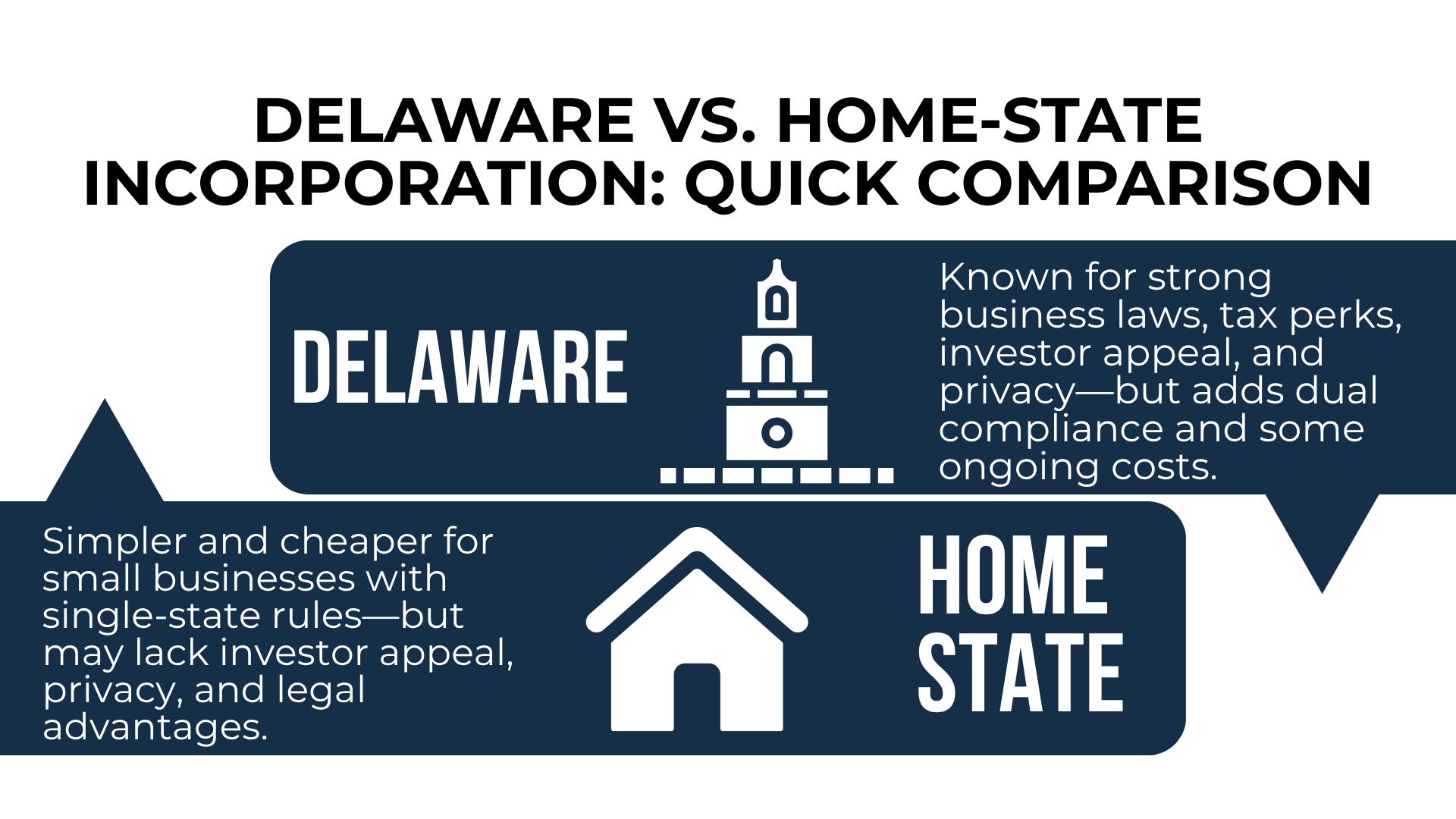
Delaware vs. Home-State Incorporation: Quick Comparison
| Factor | Delaware | Home State |
| Legal Framework | Specialized Court of Chancery, predictable laws | Varies by state, may be less business-friendly |
| Tax Benefits | No state income tax for out-of-state operations | Subject to home-state taxes |
| Investor Appeal | Preferred by VCs and angel investors | Less appealing to investors |
| Compliance | Dual compliance if operating elsewhere | Single-state compliance, simpler |
| Costs | Low filing fees, franchise tax, agent fees | Often lower for small businesses |
| Privacy | High privacy for LLCs, anonymous filings | Varies by state, often less private |
Frequently Asked Questions
Do I need to live in Delaware to incorporate there?
No, you can incorporate in Delaware from anywhere. However, you must appoint a registered agent with a physical Delaware address to receive legal documents.
Will incorporating in Delaware save me money on taxes?
It depends on your business structure and operations. Delaware offers no state income tax for businesses operating outside the state, but your home state may still impose taxes, potentially negating benefits for small businesses.
Is Delaware incorporation necessary for my small business?
Not necessarily. Small, local businesses not seeking outside funding often find home-state incorporation simpler and more cost-effective. Delaware’s benefits are most relevant for larger or investor-backed companies.
How does Delaware compare to Nevada or Wyoming?
Delaware is renowned for its corporate law and Court of Chancery, ideal for businesses seeking legal predictability and investor appeal. Nevada and Wyoming offer different tax benefits but lack Delaware’s robust legal framework. The best choice depends on your specific needs.
What are the ongoing costs of maintaining a Delaware corporation?
Key costs include:
- Annual franchise tax (minimum $175, increases with shares/value)
- Registered agent fees
- Potential home-state registration fees for businesses operating elsewhere
Additional Resources
For more information about Delaware incorporation:
- Forbes Advisor: Delaware incorporation insights (https://www.forbes.com/advisor/business/incorporating-in-delaware/)
- Stripe Atlas: Startup incorporation guidance (https://stripe.com/atlas)
- Investopedia: General business formation advice (https://www.investopedia.com/)
- Delaware Division of Corporations: Official state resource (https://corp.delaware.gov/)
The Bottom Line: Should You Incorporate in Delaware?
Delaware incorporation offers significant advantages—including a business-friendly legal system, tax benefits, and investor appeal—making it attractive for large corporations, funded startups, and businesses with multi-state operations.
However, small, local businesses may find the additional costs and compliance requirements outweigh the benefits. Home-state incorporation often proves more practical for businesses that:
- Operate in a single location
- Don’t plan to seek venture capital
- Have simple ownership structures
- Want to minimize administrative complexity
Your decision should align with your business’s specific goals, size, and funding needs. By carefully weighing Delaware’s benefits against its drawbacks and consulting with legal and tax professionals, you can determine whether Delaware incorporation supports your long-term business strategy.