Selecting the right business structure is one of the most critical decisions you’ll make when launching your startup. The choice between a Limited Liability Company (LLC) and a C Corporation (C-Corp) impacts everything from taxes and fundraising to operational complexity and long-term growth potential.
This comprehensive guide breaks down the key differences between LLC vs C-Corps for startups, helping you make an informed decision based on your specific business goals and circumstances.
Understanding Liability Protection: LLC vs C-Corps
Both LLCs and C-Corps offer robust limited liability protection, shielding your personal assets from business debts, lawsuits, or bankruptcy. However, there are subtle differences in how this protection works:
LLC Liability Protection
- Members (owners) are generally not personally liable for business obligations
- Flexible structure with straightforward asset protection
- Requires fewer formalities to maintain protection
C-Corp Liability Protection
- Shareholders protected from personal liability
- Requires strict adherence to corporate formalities
- Must maintain detailed records and hold regular meetings
Key Takeaway: Both structures provide solid liability protection, but C-Corps require more administrative effort to maintain this shield.

Taxation Differences: The Most Critical Factor
When comparing LLC vs C-Corps for startups, taxation often becomes the deciding factor, especially for early-stage companies.
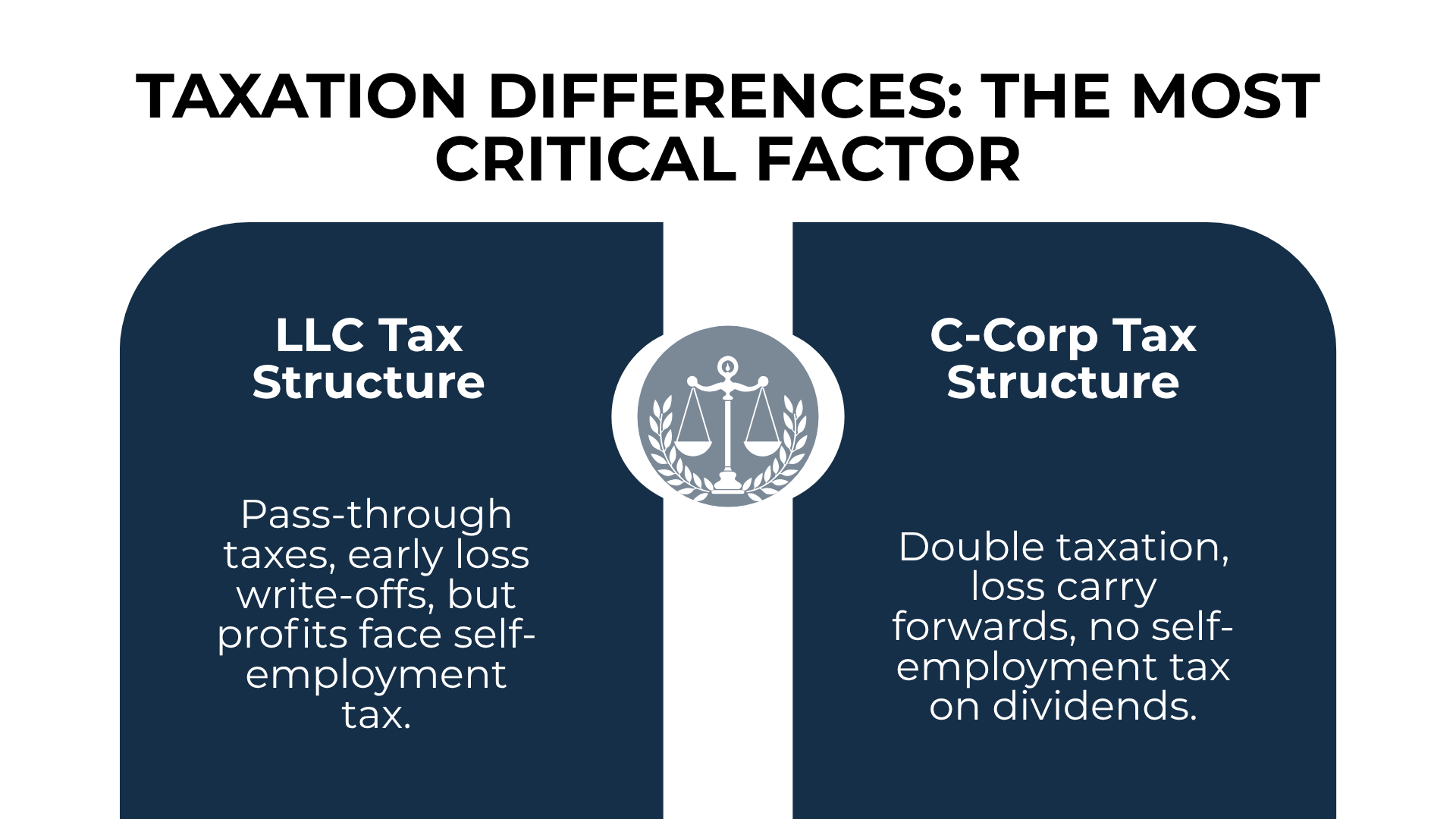
LLC Tax Structure
- Pass-through taxation: Profits and losses flow directly to members’ personal tax returns
- No corporate taxes: Avoids double taxation at the entity level
- Early loss benefits: Startup losses can offset members’ personal income, potentially reducing tax bills by thousands
- Self-employment taxes: Members pay self-employment taxes on their share of profits
C-Corp Tax Structure
- Double taxation: Corporation pays 21% federal tax on profits, then shareholders pay taxes on dividends
- Loss retention: Early losses stay at the corporate level and carry forward to offset future profits
- No self-employment tax on dividends: Only salaries subject to payroll taxes
- Ability to retain earnings: Can reinvest profits without immediate tax consequences to owners
Practical Consideration: If you expect losses in early years, an LLC’s pass-through taxation can provide immediate tax relief. For growth-focused startups planning to reinvest profits, C-Corps offer advantages despite double taxation.
Raising Capital: A Game-Changing Difference
The ability to raise capital fundamentally differs between LLC vs C-Corps for startups, often determining which structure venture-backed companies choose.
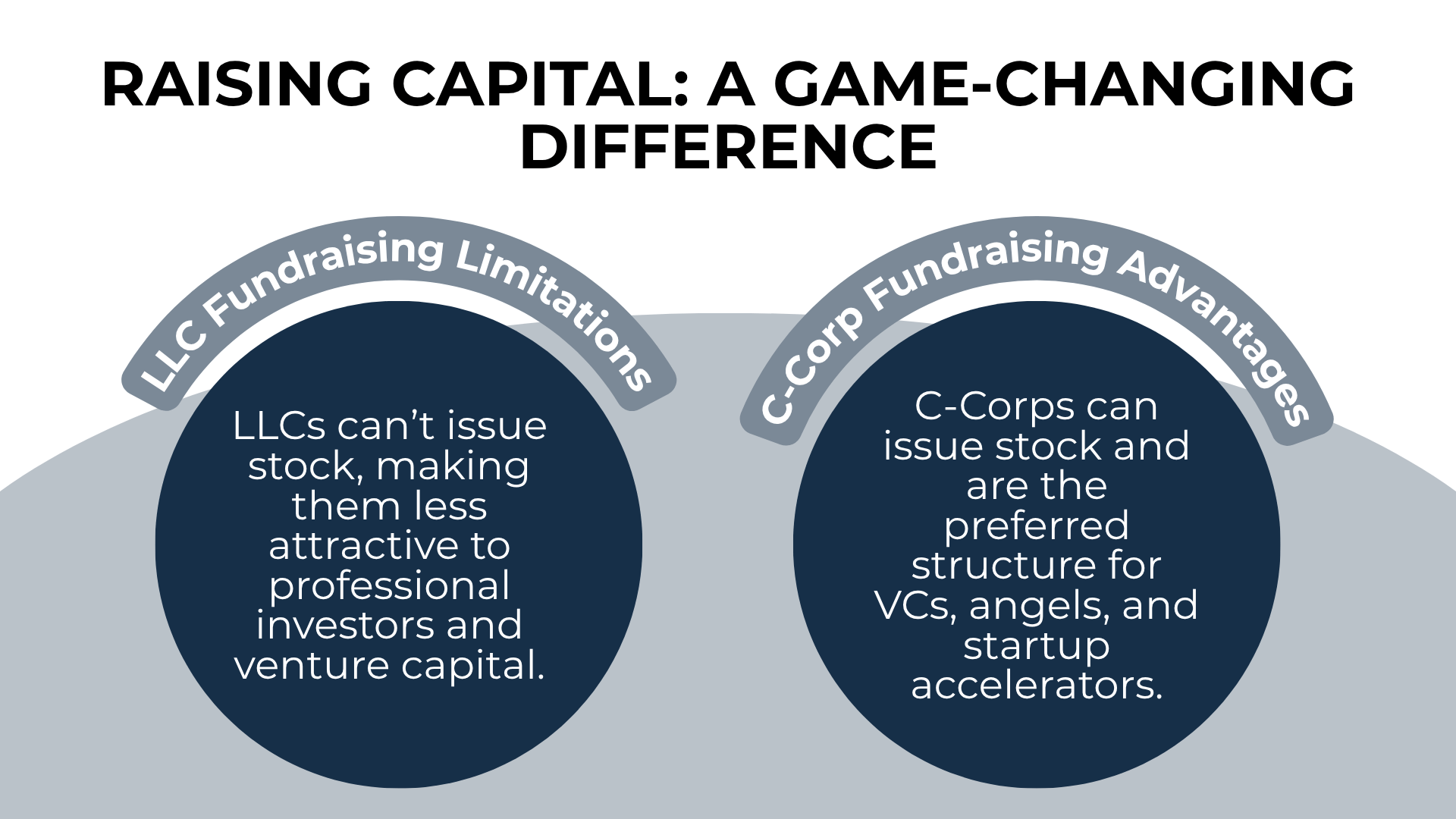
LLC Fundraising Limitations
- Cannot issue stock, limiting appeal to equity investors
- Complex membership interests may deter professional investors
- Better suited for loans or contributions from friends and family
- May require conversion to C-Corp when seeking VC funding
C-Corp Fundraising Advantages
- Can issue multiple classes of stock
- Preferred structure for VCs, angel investors, and accelerators
- Standardized structure reduces legal complexity for investors
- Y Combinator and similar programs require Delaware C-Corps
Bottom Line: If you plan to raise venture capital, a C-Corp is virtually mandatory. LLCs work well for bootstrapped businesses or those raising funds through debt.
Employee Equity and Compensation
Attracting top talent often requires offering equity compensation – another area where LLC vs C-Corps for startups diverge significantly.
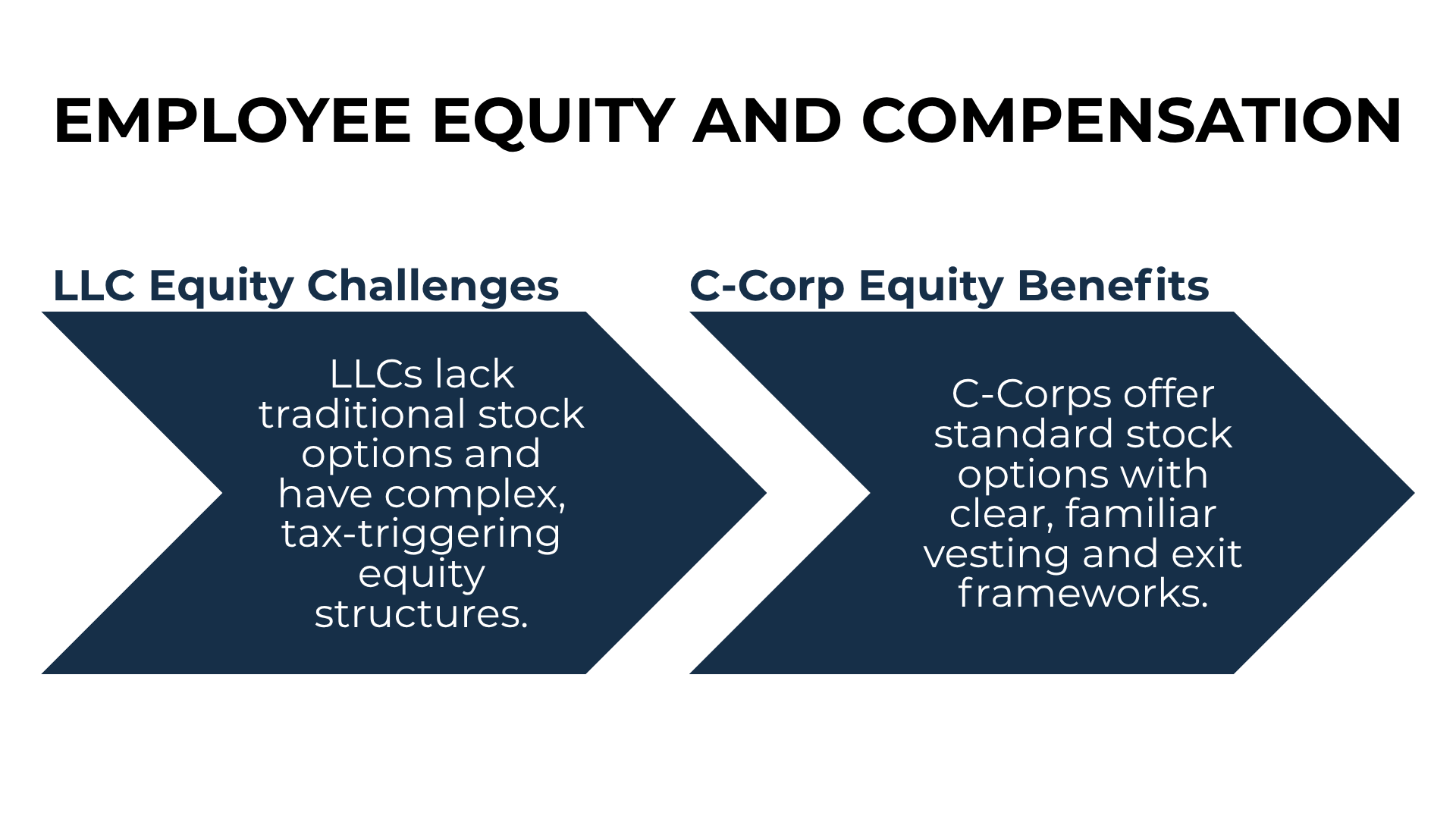
LLC Equity Challenges
- Cannot offer traditional stock options
- Membership interests are complex and may trigger immediate tax consequences
- No standardized vesting schedules
- Employee departures may require complex negotiations
C-Corp Equity Benefits
- Can offer stock options, RSUs, and other standard equity incentives
- Well-established vesting mechanisms (e.g., four-year vesting with one-year cliff)
- Familiar to employees in tech and high-growth industries
- Clear frameworks for handling departures and equity management
Key Insight: If offering equity to employees is crucial for your hiring strategy, C-Corps provide significantly better options.
Operational Complexity and Governance
The administrative burden varies dramatically between LLC vs C-Corps for startups.
LLC Operations
- Minimal formalities: No legal requirement for board meetings or extensive documentation
- Flexible management: Can be member-managed or manager-managed
- Simple structure: Ideal for small teams with limited administrative resources
- Operating agreement: Recommended but not always required
C-Corp Operations
- Formal requirements: Must hold regular board and shareholder meetings with detailed minutes
- Structured management: Requires board of directors and corporate officers
- Higher costs: Increased administrative and compliance expenses
- Corporate formalities: Must maintain to preserve liability protection

Longevity and Ownership Transfer
Planning for growth and potential ownership changes reveals another distinction in LLC vs C-Corps for startups.
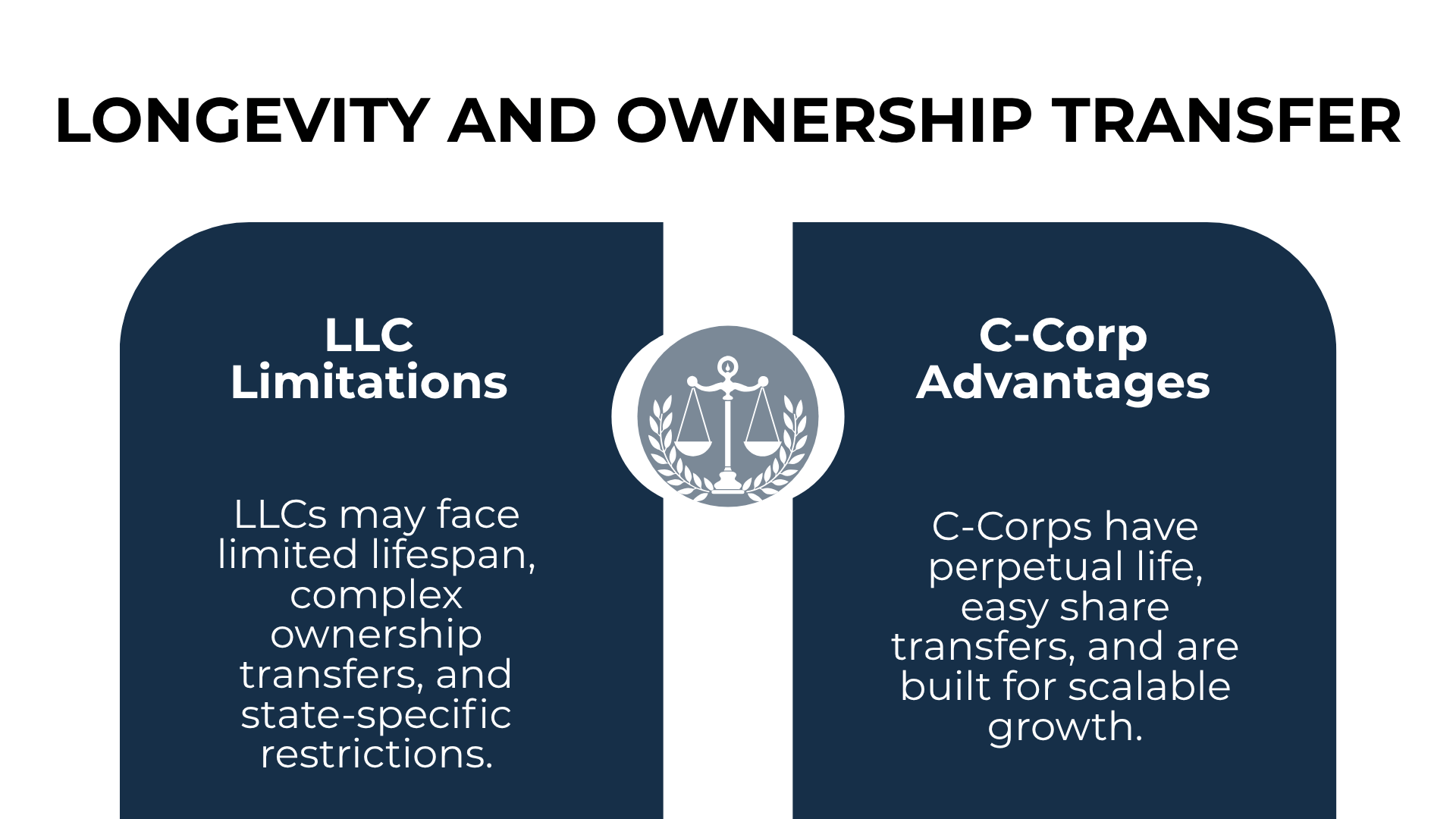
LLC Limitations
- May have limited life in some states
- Membership changes can trigger dissolution unless operating agreement specifies otherwise
- Complex transfer of ownership interests requiring member agreement
- State-specific rules may complicate ownership changes
C-Corp Advantages
- Perpetual existence regardless of shareholder changes
- Shares easily transferred or sold
- Ideal for long-term growth, acquisitions, or going public
- Facilitates ownership changes without disrupting operations
Converting Between Structures
Many startups wonder about flexibility in LLC vs C-Corps for startups decisions:
- Conversion is possible but can be complex and trigger tax implications
- Some startups begin as LLCs for simplicity, then convert when seeking VC funding
- Planning ahead can minimize conversion costs and complications
- Delaware formations provide the most flexibility for both structures

Common Scenarios: Which Structure Fits Your Startup?
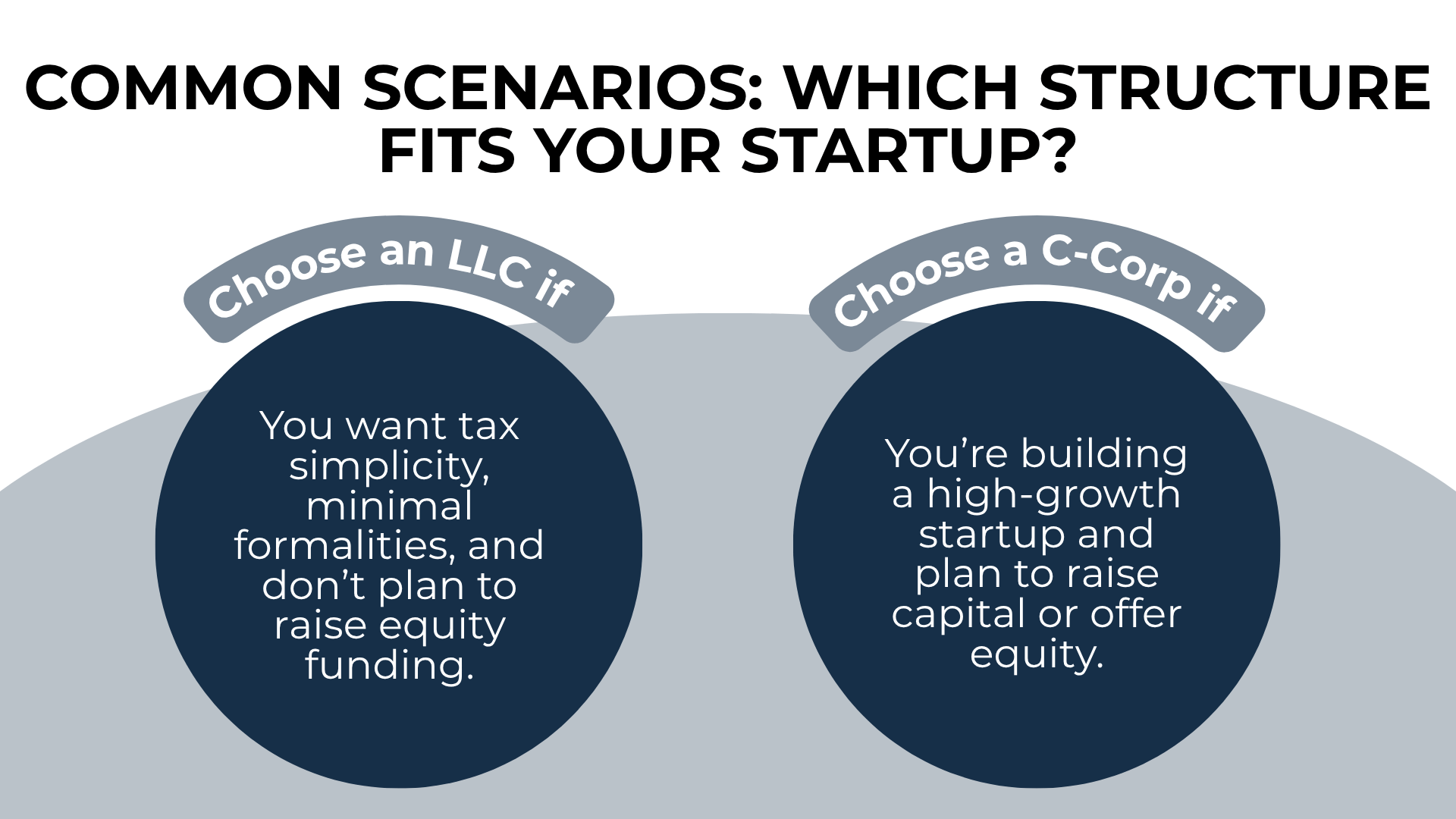
Choose an LLC if you’re:
- Building a bootstrapped business without plans for equity investment
- Expecting early losses and want immediate tax benefits
- Operating with a small, stable team
- Prioritizing operational simplicity over fundraising flexibility
Choose a C-Corp if you’re:
- Planning to raise venture capital or institutional investment
- Offering equity compensation to attract talent
- Building a high-growth startup with acquisition or IPO potential
- Participating in accelerator programs like Y Combinator
Frequently Asked Questions
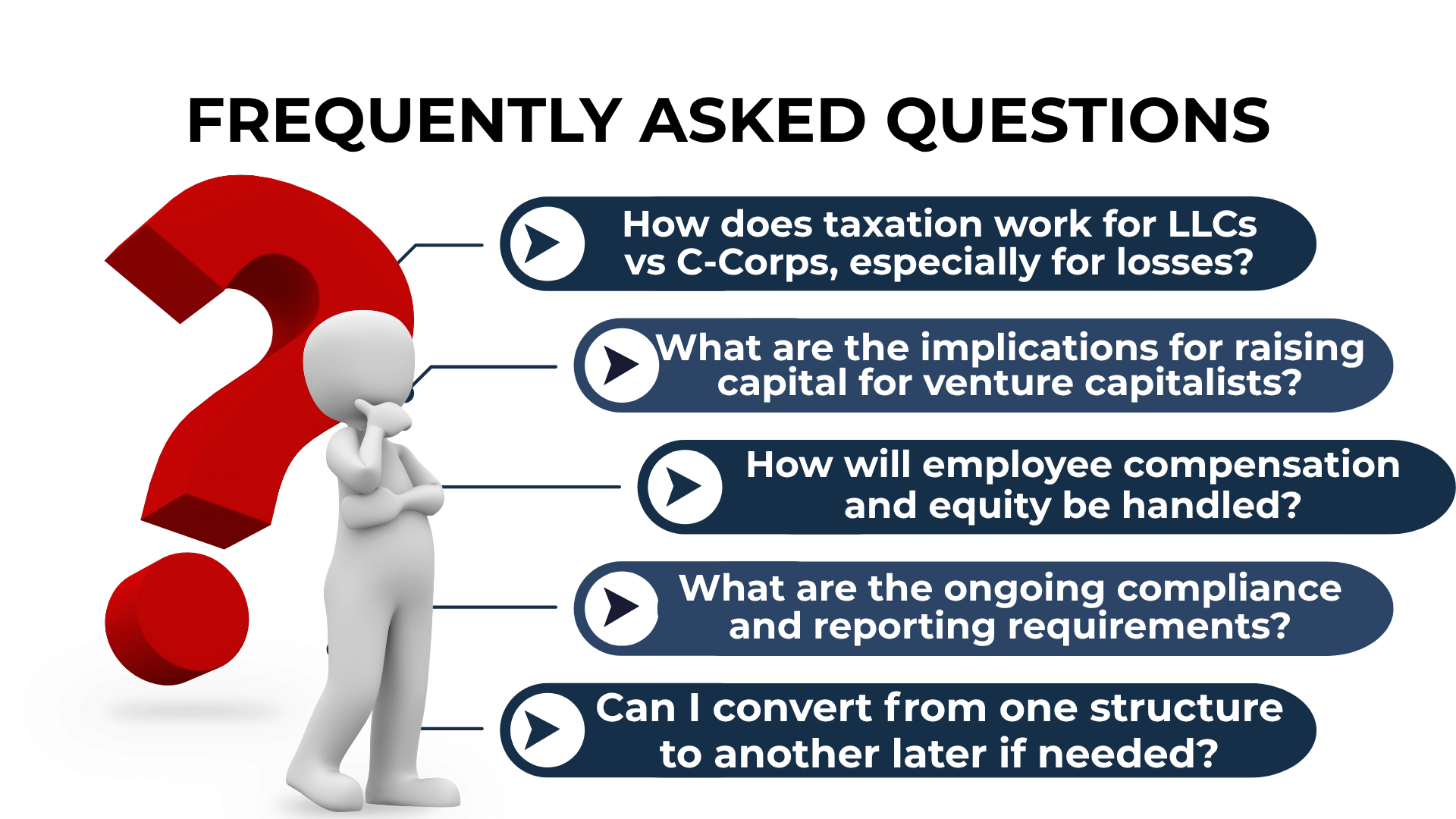
How does taxation work for LLCs vs C-Corps, especially for startups with losses?
LLCs offer pass-through taxation where losses can immediately offset owners’ personal income, providing tax relief. C-Corps retain losses at the corporate level to offset future profits, offering no immediate personal tax benefit.
What are the implications for raising capital, particularly from venture capitalists?
VCs strongly prefer C-Corps due to standardized equity structures and familiar legal frameworks. LLCs face significant barriers to institutional investment and often must convert to C-Corps to secure VC funding.
How will employee compensation and equity be handled under each structure?
C-Corps can offer standard stock options and equity incentives with established vesting schedules. LLCs cannot offer traditional stock options, making equity compensation complex and potentially less attractive to employees.
What are the ongoing compliance and reporting requirements?
LLCs have minimal formal requirements, while C-Corps must maintain detailed records, hold regular meetings, and file extensive documentation to maintain corporate status and liability protection.
Can I convert from one structure to another later if needed?
Yes, conversion is possible but involves complexity and potential tax implications. It’s better to choose the right structure initially based on your long-term plans.
Best Practices for Choosing Between LLC vs C-Corps for Startups
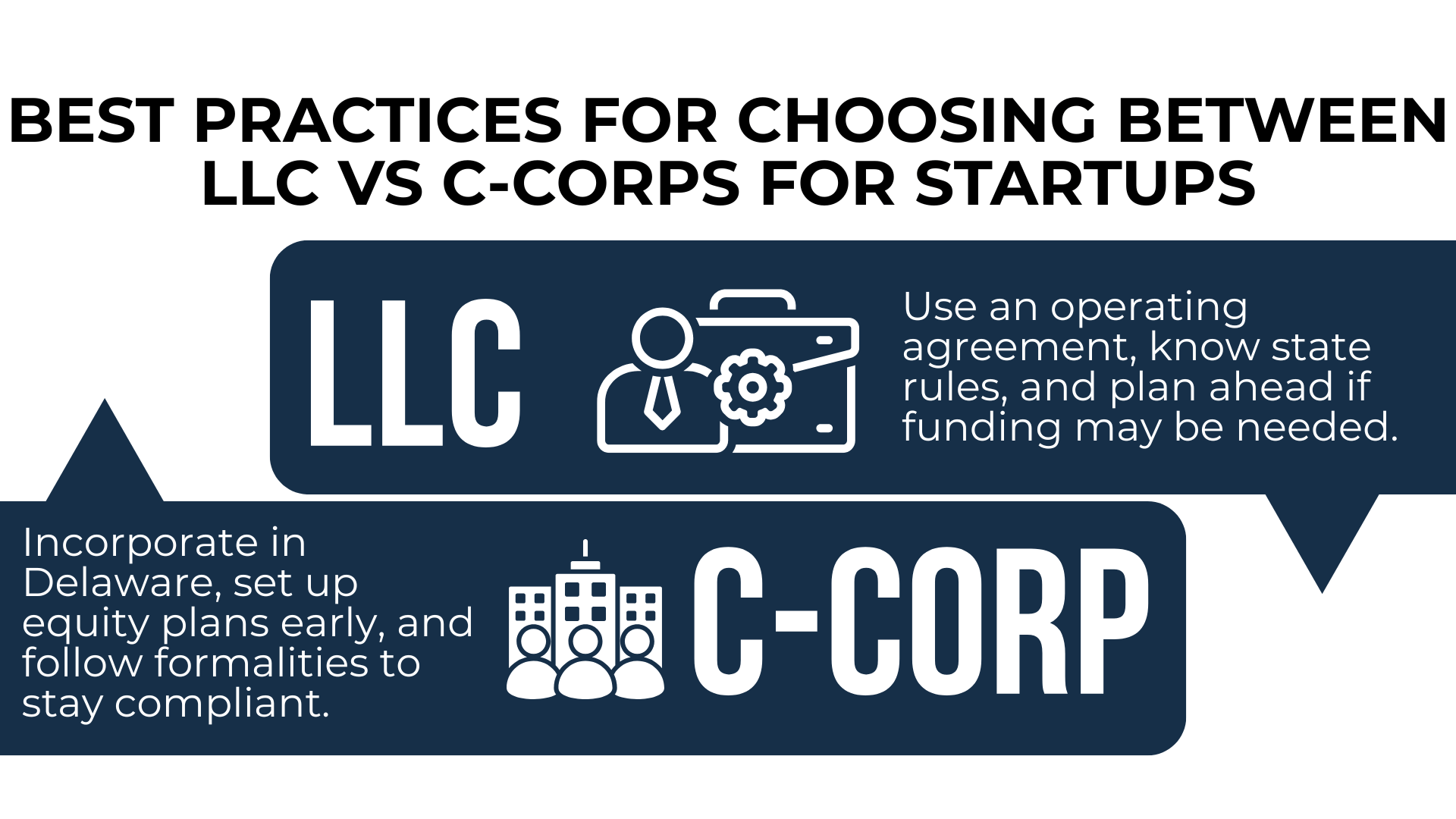
LLC Best Practices:
- Create a comprehensive operating agreement addressing ownership changes and management
- Consider LLCs for simple operations with few owners and no equity investment plans
- Research state-specific rules regarding longevity and membership restrictions
- Plan for potential conversion if venture funding becomes likely
C-Corp Best Practices:
- Incorporate in Delaware for business-friendly laws and legal predictability
- Establish equity incentive plans early to attract talent
- Budget for higher administrative costs and compliance requirements
- Maintain corporate formalities to preserve liability protection
General Recommendations:
- Consult with tax professionals and attorneys before deciding
- Assess long-term goals including fundraising, growth, and exit strategies
- Consider industry norms – tech startups typically choose C-Corps
- Factor in Qualified Small Business Stock (QSBS) benefits exclusive to C-Corps
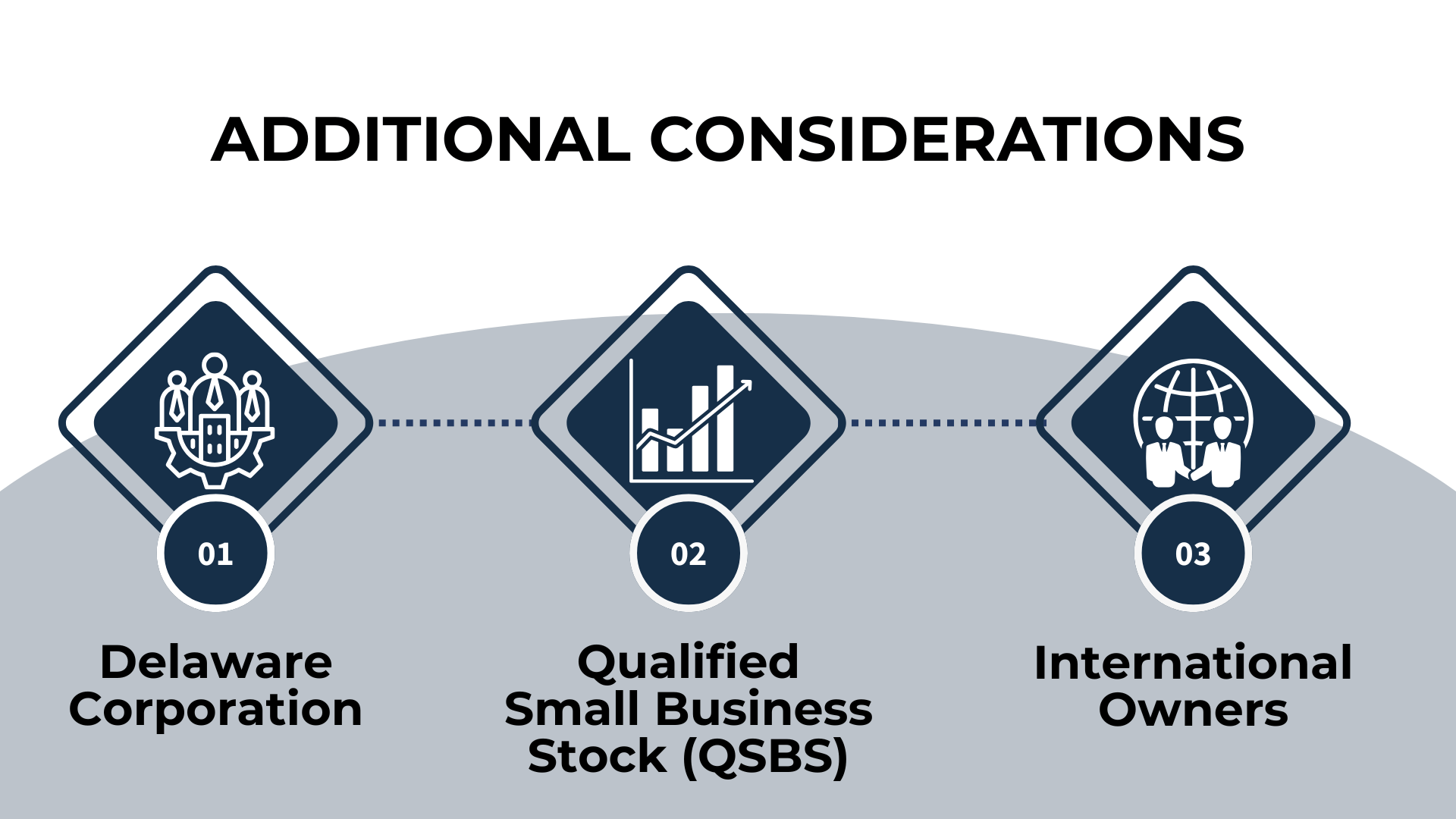
Additional Considerations
Delaware Incorporation
Both LLCs and C-Corps often form in Delaware due to its well-established legal framework and business-friendly environment, particularly common for VC-backed startups.
Qualified Small Business Stock (QSBS)
C-Corps qualify for QSBS tax benefits, potentially exempting capital gains on stock sales after five years. LLCs cannot access this significant tax advantage.
International Owners
Neither structure requires citizenship or residency, but nonresident owners face more complex tax situations with LLCs due to pass-through taxation.
Conclusion
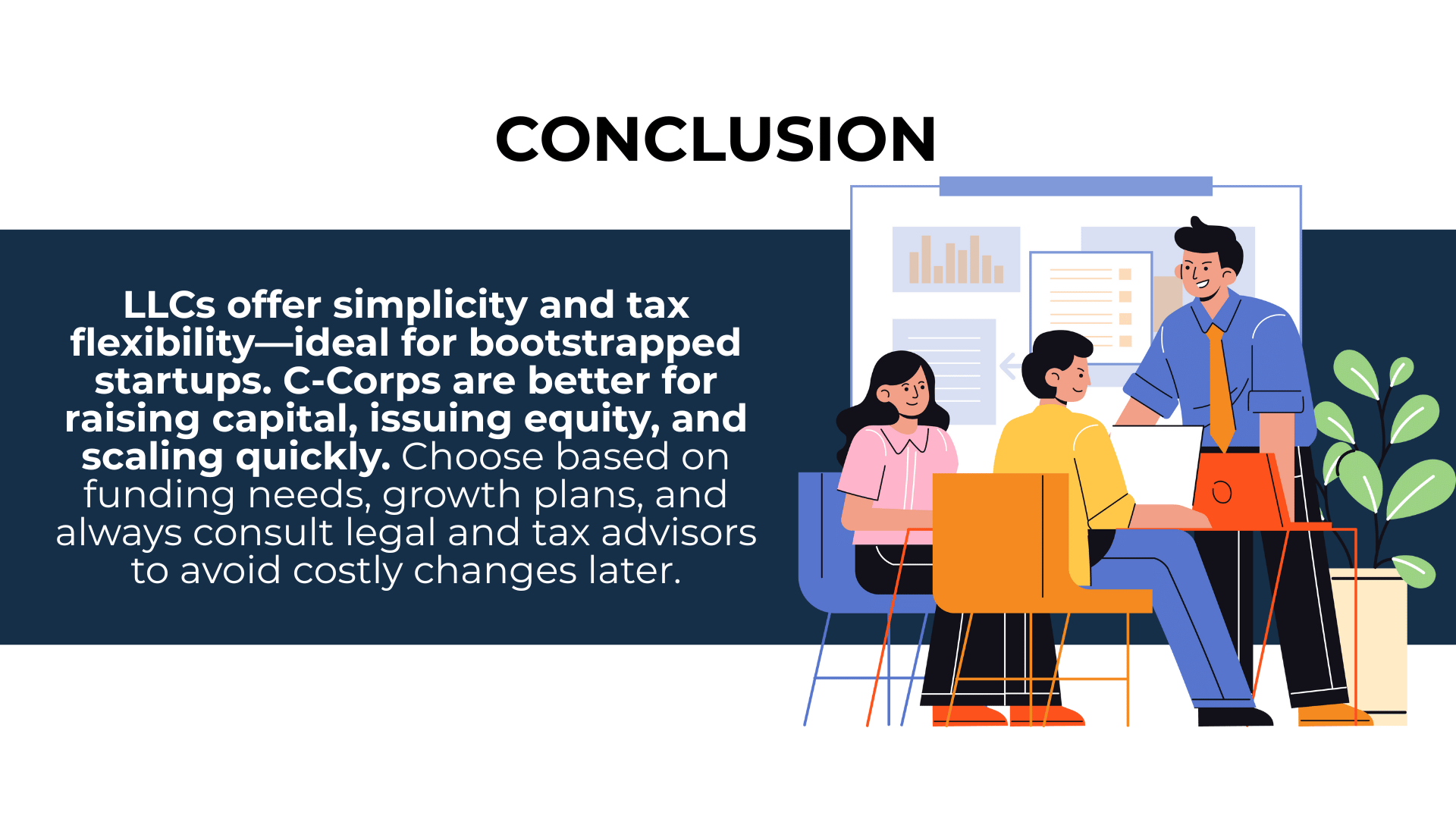
The choice between LLC vs C-Corps for startups fundamentally shapes your company’s trajectory. LLCs excel for bootstrapped businesses prioritizing simplicity and tax efficiency. C-Corps dominate when raising capital, offering equity, or planning for significant growth.
Consider your startup’s specific needs:
- Funding requirements
- Tax strategy
- Operational capacity
- Long-term growth plans
Most importantly, consult with legal and tax professionals to ensure your choice aligns with your unique circumstances. The right structure sets the foundation for your startup’s success, while the wrong choice can create costly obstacles down the road.
Remember: while conversion between structures remains possible, selecting the optimal structure from the start saves time, money, and complexity as your startup grows.